The physical properties of soil are characteristics that describe the physical state and behavior of soil.
The physical properties of soil are characteristics that describe the physical state and behavior of soil. These properties influence the ability of soil to support plant growth, retain water, and interact with the surrounding environment.
Before physical properties of soil lets understand some basics :-
Soil -
Is a uppermost, un-consolidate, powdery, porous layer of the earth's crust formed by weathering of minerals and decomposition of organic matter by soil organism.
It provide stratum for life.
S - Stratum or Soul
O - Of
I - Infinite
L - Life
Pedology -
G: Pedon-Soil or earth + Logos-Study or discourse
It is study of soil origin, classification, survey and distribution.
It considered the soil as natural body of nature.
It does not focus primarily on soil's immediate use.
Edaphology -
G: Pedon-Soil or ground + Logos-Study or discourse
It deals with influence of soils on living things particularly plant growth.
It is study of soil from the stand point of higher plants.
Considers the properties of soil in relation to plant growth.
Soil as a natural body contains 4 major constituents -
- Inorganic or Mineral matter
- Organic Matter
- Soil Water
- Soil Air.

Inorganic or Mineral matter -
Organic matter -
Comprises the Partially disintegrated and decomposed plant and animal residues.
Beside that Micro-organism also synthesizes organic matter by decaying the residues.
Its maintenance requires continuous addition of organic matter by the decaying process of the residues.
Availability of OM is (↑) in surface soil than in sub-surface soil.
OM plays a significance role in the soil productivity.
Soil Water -
Soil water occupies aprox. 25% of soil space.
Soil water depends upon the pore space size.
Soil dissolve the nutrients to form the solution which is food of plants.
Presence of soil significantly influence the physical, chemical and biological properties of soil.
More in soil water of physical properties
Soil Air -
Air occupies those space or pores not filled by the water.
Air composition of are different from the atmospheric air.
It contains higher amount of CO2 than atmosphere.
Oxygen is less than the atmosphere.
Significance -
Growth of plant and root development - In poor aeration plant root restricted, absorption of water and nutrient decreases,
Microbes - Microbial activity depends on the aeration of soil, more air provides more O2
to microbes for respiration and increases rate of decomposition.
If CO2
increases in the soil anaerobic respiration take place and some toxins releases (lacitc, butyric etc) which have negative influence on the plant growth due to root injury. N2 fixation also depend on air of soil.
Nutrient absorption - Uptake of nutrients is a result of gaseous exchange of air and change the metabolic activity.
Soil Property
Physical property -
Texture,
Structure,
Density,
Porosity,
Consistency,
Colour,
Temperature and
Water
Soil texture -
Relative proportion or percentage of particles (mineral particles) of various sizes such as sand, silt, and clay.
Almost permanent (Basic) property of soil.
May change slowly.
Generally size <2 mm diameter considered as soil.


>80% of silt - silty
>40 of clay - clay
Loam soils - 23-52% of sand, 28-50% of silt, 7- 27% of clay.
Significance of soil texture -
To access the value of land.
Land capability and management of soil
Suitability to grow the different crops.
Suitability for foundation of building and road construction.
Total pore space for water and air availability.
Ability to hold and supply nutrient.
Most stable property
Evaluate the amount of amendment needed for reclamation.
Determined the temp. of soil.
Soil Structure -
Studying the soil texture or separates is not enough to understand the soil body, but the various soil structure in which soil particle held to gather by complex network is necessary to understand the soil.
Indiavidual primary particles not exist separately but combine in various larger units or aggregates called secondary particles.
arrangement of primary particles (sand, silt and clay), secondary particles (aggregates) and pores in to a certain definite pattern under field conditions’
When we discuss about Soil structure should keep in mind all these 3 -
size, shape and arrangement of particles and aggregates
size, shape and arrangement of the spaces separating particles and aggregates
combination of pores and aggregates in to various types of structures


Shape of Soil Structure -
Classification of soil structure based on shape of peds.
Plate Like
Horizontal dimensions are more developed than the vertical dimensions.
Looks like as lens or flat peds.
When units are thick called platy and thin called laminar.
Inherited from parent materials carried by water or ice.
Found in surface layers of some virgin (soil not cultivated before) soils.

Prism Like

Block Like

Spherical
All dimensions developed equally in irregular faces.
All rounded aggregates forms such type of structure.
Found in horizons O and E horizons.
Aggregates of such soils called granule and less porous
When more porous called crumb.
It is best for plant growth and cultivation.
Spherical soils are greatly found in clay soils and less in sandy soils.

Factors affecting soil structures-
Climate -
Arid Region less aggregation
Humid region more aggregation
Organic matter -
OM is major agent for aggregation and formation of granular structure of soil.
During the decomposition of OM many organic compound and slimy material helps to formation of aggregates by binding the particles.
Cations -
Na+ and K+ plays deflocculation role
Ca+ and ---- favours the flocculation process.
Tillage -
For the development of good structured soil tillage should be done at proper moisture otherwise if soil is moist then big clods are forms.
Micro-organism -
Microbial decomposition of plant and animal residues binds the soil particles.
Earthworm and other insects makes soil more porous which directly affect the soil structure.
Soil moisture -
In well irrigated soils, good structure develops
Dry soil have influences formation of bad soil structure ===Clods, cracks
Vegetation -
Grassland, forest and legumes having the high aggregation ability
while corn have opposite effect.
Roots -
Root secretion have the binding effect for the particles of soil to form good soil structures
Roots hairs also holds granule of soil on the surface favores granular structure of soil.
Manures and Crop rotation -
Green and organic manures improves the soil structures.
Crop rotation like wheat-jowar and wheat maize improves the soil structures.
Soil moisture -
Drying of soils forms crack in the soil and poor drainages have poor soil structure.
Soil Density -
Generally density is weight substance available in per unit volume of that substance.
Soil density means weight of soil in per unit volume of soil.
Expressed in g/cm3
S.D. grouped into two types -
Particle density -
Bulk density -
Particle Density -
Weight or Mass in per unit volume of soil.
It depends on Chemical composition and crystals of minerals.
It has no impact of soil structures
PD is also a permanent character of soil like texture of soil.
Particle density of most minerals are = 2.60-2.75 g/cm3
Humus 1.3-1.5 g/cm3
Clay 2.2-2.6 g/cm3
Bulk Density -
mass per unit volume of dry soil (volume of solid and pore spaces).
Always smaller than the PD.
Fine textured soil - Clay have low BD than the sandy soils.----
Loose soil have less B.D. than the compact soil.
Soil pores and BD is inversely related.
Generally it ranges from 1.33 g/cm3.
BD = Weight of soil/Volume of soil and pores.
Factors affecting BD -
Pore space (↑) = BD (↓)
Compactness (↑) = BD (↑)
Depth (↑) = BD (↑)
Fine Texture = BD (↓)
O.M. (↑) = BD (↓)
Crumby soil structure (↓) = Platy (↑)
Tillage reduces BD
Croppin increases the BD of top soils.
Importance of BD -
BD determines = Pores spaces = Helps in Soil-Water-Air = Facilitate plant growth.
It also determines -
Infiltration
Percolation
Permeability and
Water retention capacity of soils.
Soil Porosity -
Percentage of Soil volume occupied by pore space known as SP.
Voids or pores constitute the soil which is not occupied by solids like mineral or organic.
Void are filled generally by air and water.
Soil Pores -
Macropores - >0.06 mm, Generally in sand size soils.
Micropores - <0.06 mm, Imp. for crop growth, Found more in clay soils.


Soil Structure - Granular structure (↑) pores while Platy (↓), Aggregated structure (↑), single grain (↓)
Soil texture - Sandy (↓), Fine textured clay and clay loam (↑)
O.M. - (↑) aggregation, (↑) porosity.
Depth - (↑) depth, (↓) porosity.
Organism - (↑) Organism, (↑) Porosity.
Cultivation - Intensive cultivation, (↓) in porosity due to loss of organic matter content.
Soil Consistency -
Resistance of soil material to rupture.
Manifestation of the physical forces of the cohesion and adhesion acting within the soil at various moisture constant.
Soil consistency depends on the texture, structure, inorganic and organic colloids and moisture content.
It describe at 3 moisture content levels wet, moist and dry.
Soil Color -
Soil color not directly affect the plant growth but describe the genesis of soil and climatic condition of a regions.
Color of soil is due to organic or inorganic matter content of soil.
Different inorganic and organic matter imparts the different color like -
Organic matter / humus - black to dark grey
Iron - Red
Iron - Brown
Iron - Yellow
Reduced Iron - Blue
Quartz - White
Lime stone - White, Grey
Significance of soil color -
Tells climatic condition, parent material of a region -
Basic rock - Darker than the acidic rock.
Humid temperate - Grey
Tropical and sub-tropical - Red and yellow
Dark color more productive.
Black > brown > rust brown > gray brown > red > gray >yellow > white
For soil profile description.
Soil formation process.
Depression (Dark) and adjacent upland area (Light)
Soil Temperature -
Degree or measurement of energy are called as temperature.
It is coldness and hotness of any things.
Significance of Temp. -
High temp and low temp not good for crop development -
Germination - ----℃
Root growth - 10-27 ℃
Crop growth - 15-45 ℃
Nutrient availability - Weathering of minerals.
Organic matter decomposition - Temp. for microbial development = Rest-<10℃, Ceases-<5℃.
Nitrification and ammonification affected by too High and too low temp.
Soil Water -
Water is a universal solvent and hence necessary for nutrients dissolution in soil for better plant growth.
Water remain soil in place of air, Soil pores are filled by soil water, if water decreases air increases and vice versa.

Gravitational Water -
Held at tension of -0.1 to -0.3 atm.
Free water drains out.
Drainage water.
Present in macropores.
Undesirable because nutrient leaching takes place.
Downward movement due to gravitational force hence called gravitational water.

Capillary Water -
Present in soil capillaries hence called capillary water.
Held between field capacity and hygroscopic coefficient in micropores.
Soil water tension varies from 0.1-31 atm.
Functions as soil solution.
Moves from thick to thin film.
Related to organic matter content and texture of soil.
Hygroscopic Water -
Held at hygroscopic coefficient.
Tension varies from 31-10,000 atm.
Held by soil colloids.
Non-liquid and biologically inactive.
Moves in vapor form.
Related to organic matter content and texture of soil.
Biological classification of water
In this classification water is grouped on the basis of availability of waater for plants utilization.
1. Available water -
Available water are those water which is held between field capacity (-1/3 bar) and permanent wilting coefficient (-15 bar).
It is easily available for plants hence called available water.
AW=FC-PW

2. Un-Available water -
Held at >-15 bars.
It is unavailable to plants.
UW=Water below the -15 bars

3. Superfluous water -
Water held above the field capacity (-15 bars).
Unavailable to plant.
If retain for longer period in soil causes harmful effect on the plant growth due lack of water.
SW=Above the FC+some CW.

Why water combines with other molecules?
Different forces are responsible for attraction of molecules.
Water molecules have two types of charged - one is positive hydrogen side and another is negative oxygen side.
When like molecules attracts to each other called cohesion and when unlike attracts called adhesion.
Attraction between colloids and water - adhesion
Attraction between water and water - cohesion.

Water Potential -
Water potential means potential energy and kinetic energy of water in the soil to do some work with reference to pure water.
Potential energy is greater than kinetic energy in water potential of soil due to low movement of water.
Free energy - Results of all energy having the Ability to do work.
Energy status of water - strength with which water is held.
Pressure required to remove the water from the soil is called atmospheric pressure.
Atmospheric pressure is opposite to surface water tension because surface tension essential for holding the water in the soil while pressure is responsible for removal of water from the soil.
Free energy less (water potential) in adsorbed water (impure water) and more in pool water (water in a chamber).
When TP of water is constant at every place in the soil, water called as in static equilibrium.
In such scenario acting force on water to move is "0"
Movement of water is happens when force on water is not equal to zero.
Units of soil water potential -
Height of water column in cm - higher the water column greater the potential
Standard atmospheric pressure at sea level - Weight of 1020 cm of water column
Bar also used as unit - 1 bar = 0.9869 atm aprox. 1 atm= 1020 cm of water column.
Soil water potential = Matric potential + osmotic or solute potential + pressure potential
Total water potential = Soil water potential + soil gravitational potential.
Matric potential =
It is combined effect of adsorption and capillary action of water.
In this phenomenon water attracts towards soil solids and exchangeable ions and loses the energy.
It causes reduction of free energy.
It is always negative due to loss of free energy.
Osmotic potential =
It is because of solutes available in soil.
When any solutes dissolves in water, reduced the free energy of water.
Osmotic potential is the work to be done to detach these ions from water molecules.
It is important process involves in the absorption of water by the plants from the soil.
Negative in nature.
When osmotic potential of solutes increased due to excess salts then plant unable to absorb the water from the soil.
Pressure potential =
it is due to weight of water or atmospheric or gas pressure effect at certain point.
Soil gravitational potential =
The force of gravity acts on soil water, the attraction being towards the
earth’s center.
GP always positive Point of reference always chosen at below the soil surface.
Hence always water moves down due to GP.
It is very beneficial for removal of excess rain water from the soil.
Soil pF -
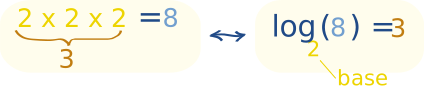
23=8
“logarithm to the base 10 of the numerical value of the negative pressure of the
soil moisture expressed in centimeters”
pF=log10(-h)
p=Logarithmic value
F= Free energy
-h=Height of water column
Height of water column (cm) | atm | pF |
1 | 0.001 | 0 |
10 | 0.01 | 1 |
100 | 0.1 | 2 |
346 | 1/3 | 2.53 FC |
103 | 1.0 | 3 |
104 | 10.0 | 4 |
15,849 | 15.0 | 4.18 WP |
31,623 | 31.0 | 4.50 HW |
105 | 100.0 | 5 |
106 | 1000.0 | 6 |
107 | 10000.0 | 7 |
Water of constitution and inter layer water = pF >7.0
Hygroscopic water = pF 7.0 – 4.5
Capillary water = pF 4.5 – 2.5
Gravitational water = pF 2.5 – 0.0
Ground water = Tension free
Soil Moisture Constants -
Reference point | Height of water column (cm) | atm | pF |
| 1 | -0.001 | 0 |
| 10 | -0.01 | 1 |
| 100 | -0.1 | 2 |
Field Capacity | 346 | -1/3 | 2.53 FC |
| 103 | -1.0 | 3 |
| 104 | -10.0 | 4 |
Wilting Coefficient | 15,849 | -15.0 | 4.18 WP |
Hygroscopic Coefficient | 31,623 | -31.0 | 4.50 HW |
| 105 | -100.0 | 5 |
Air Dry Soil | 106 | -1000.0 | 6 |
Oven Dry Soil | 107 | -10000.0 | 7 |
1. Field Capacity -
Capacity of the soil to retain water against the downward pull of the force of gravity
Held at -1/3 atm pressure.
At this stage, only micropores or capillary pores are filled with water
It is available soil water to the plants and microorganism.
2. Wilting Coefficient -
Plants start wilting due to lack of water is termed the Wilting Point
Percentage amount of water held a this point is known as wilting coefficient.
It held strongly with soil.
Held at -15 atm.
At primary stage like wilting point plants start wilting but if water not supplied to field then plant dies and can’t recover it is called as permanent wilting point.
3. Hygroscopic Coefficient -
Hygroscopicity is the ability of a body to adsorb moisture from the atmosphere.
It s ability of soil to absorbs the moisture from the atmosphere at 50% relative humidity and 15℃ temp.
It held at about 31 atm.
Not available to plants but may be available to some microorganism.
Rest point are not much important for agriculture optional point of view.
Almost all the important physical property of soil completed here but soil profile provided in another blog.
UPSC Agriculture Optional Previous Year Question Factors affecting soil structure 2013 |
UPSC Agriculture Optional Previous Year Question Soil Texture and Soil Structure 2009 |
UPSC Agriculture Optional Previous Year Question Soil structure and steps for development 2006 |




COMMENTS